

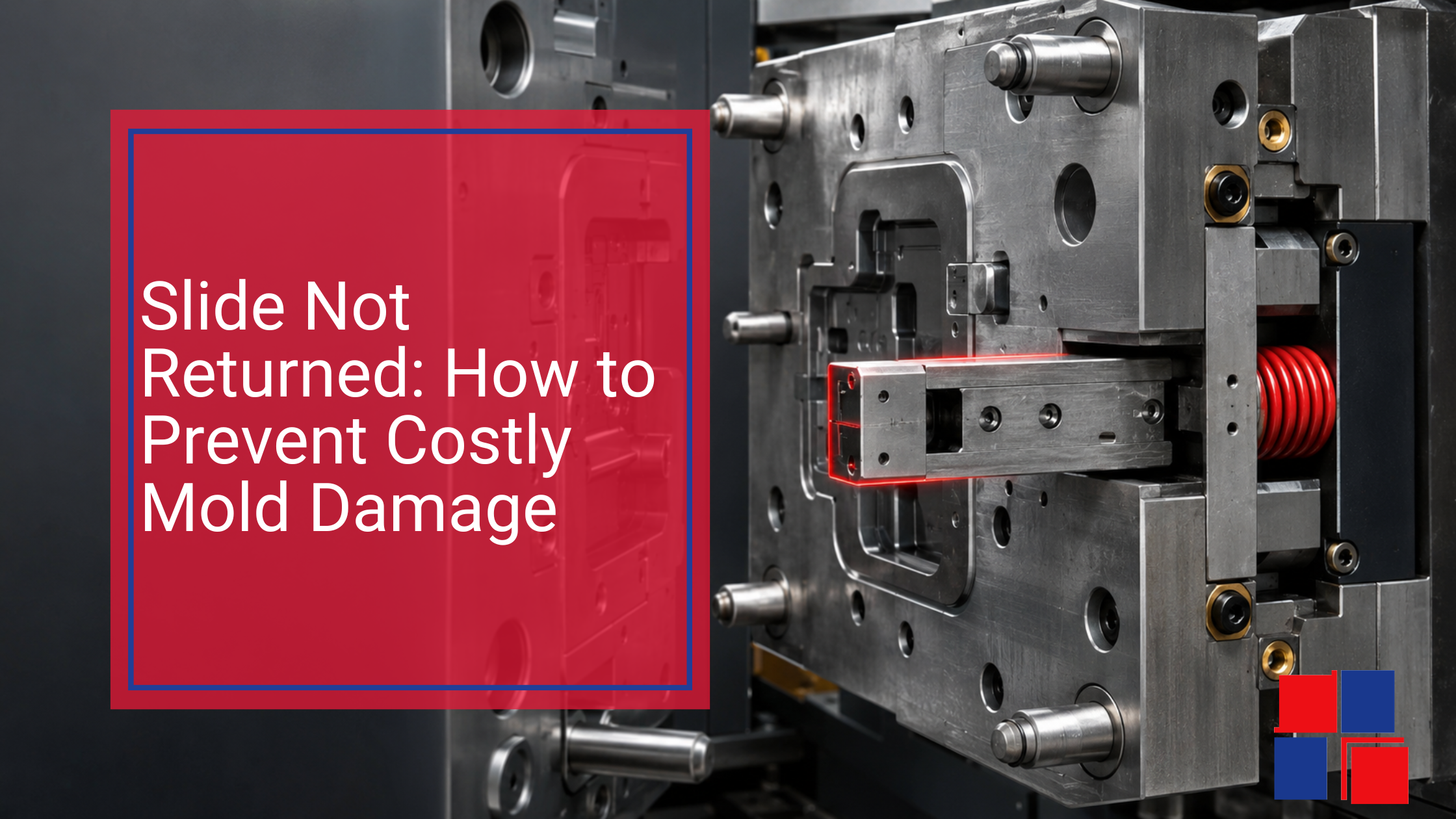
What does “slide not returned” mean?
A slide (side action) is “not returned” when it is not fully seated in its home/locked position before the mold closes. Even a small misposition can cause:
- shutoff galling/chipping
- bent angle pins
- cracked inserts
- sudden flash from incomplete shutoff contact
Once force is applied during close, damage happens fast—exactly why mold protection matters. [1]
Why this failure mode is so expensive
A slide can be “almost” home and still damage a tool. The mold closes; the slide interferes; the shutoff takes the hit. In many plants, the first clue is a repair bill and downtime.
Root causes of slide-not-returned events
1) Debris / contamination in the slide path
The most common cause is also the simplest: something is physically blocking full return—flash strings, pellet dust, regrind fines, grease-packed debris, or metal chips.
Quick checks
- Clean the slide path and shutoff surfaces
- Look for a “witness trail” where debris is being dragged
- Check for sudden flash that suggests incomplete shutoff contact
2) Gib/heel block wear (the slide “home” moves over time)
Slides rely on wear surfaces (gibs, wear plates, heel blocks/stop blocks) to guide and seat properly. Component wear can change alignment and increase friction, making return inconsistent. Mold component catalogs and standards show how these parts are intended to work together (gibs/heel blocks/stop blocks). [2]
Quick checks
- Compare current witness marks to “normal” (new shiny rub lines = change)
- Check for uneven contact on gibs and heel blocks
- Inspect stop/heel block faces for rounding or galling
3) Lubrication problems (too little, too much, wrong type)
- Too little → friction increases, galling starts, return becomes sticky
- Too much → grease attracts debris and creates “grinding paste” in the slide path
Lubrication guidance for mold moving components emphasizes appropriate lubricant selection and routine application intervals. [3]
Quick checks
- Is grease migrating into the slide travel area?
- Is there dry scoring on contact surfaces?
- Does the slide move smoothly by hand during PM (when safe and locked out)?
4) Angle pin / horn pin issues (binding or misalignment)
Angle pins drive many slides. If alignment is off or wear increases, a slide may travel out but not return cleanly—especially at higher cycle speeds.
Quick checks
- Look for uneven wear on the angle pin
- Check that slide movement is smooth through full travel
- Verify the slide isn’t “cocking” in the guide
5) Return force / return mechanism problems
If the slide return relies on springs, hydraulic/pneumatic force, or return pins, weak return force can leave the slide short of fully seated—especially when friction rises from wear or debris.
Quick checks
- Does the problem show up more after long runs (heat + friction)?
- Does slowing the cycle “fix it” temporarily?
- Check springs/return elements during PM for fatigue or damage
6) Timing drift and sequence changes
A slide can be mechanically fine but still fail due to timing:
- startup changes
- cycle time optimization
- robot/EOAT timing adjustments
- different operator interventions
This is why it often happens “once per shift” or “only at full speed.”
Quick checks
- Does it happen only at higher speeds?
- Does it happen after startup or changeover?
- Does the robot ever enter the mold area while the slide is moving?
Early warning signs (catch it before the crash)
Watch for these “leading indicators”:
- New witness marks on shutoffs/slide faces
- Sudden flash increase (incomplete shutoff contact)
- Intermittent safety alarms that “go away” when slowed down
- Cycle-to-cycle inconsistency during slide movement
- Operators needing to “help” parts clear (sticking can trigger slide interference)
Internal link: Stuck parts blog + checklist (your new post + Mold-Clear checklist)
Quick checks: a 10-minute floor workflow
Step 1 — Confirm the symptom
- Is the slide truly not returning, or is the indicator/sensor misreading?
Step 2 — Rule out physical blockage first
- Clean slide path + shutoff area
- Remove stringers/flash buildup
- Inspect for chips or grease-packed debris
Step 3 — Check friction and wear
- Gibs/wear plates/heel blocks contact condition [2]
- Scoring/galling signs
- Lubrication quality and placement [3]
Step 4 — Check drive and return
- Angle pin wear and alignment
- Return elements/springs/return pins condition
- Does return improve when slowed? (timing/friction indicator)
Step 5 — Check sequence/timing
- Startup and speed changes
- Robot/EOAT entry timing
- Any recent process adjustments that changed cycle timing?
Best practice prevention: verify before mold close
The highest-leverage checkpoint is right before close, when the cost of being wrong is highest:
✅ slide returned and seated
✅ lifters returned
✅ moving cores at home
✅ part removed / mold area clear
Vision mold protection is specifically used to confirm “mold clear” and component positions before close, helping prevent tool damage events. [1]
Safety note (important)
Machine guarding and interlocks are there for a reason. OSHA guidance for injection molding equipment emphasizes interlocks and explicitly warns against bypassing safety interlocks. [4]
FAQs
What’s the most common cause of a slide not returning?
Debris/buildup in the slide path and shutoff area is one of the most common causes, followed by wear on gibs/heel blocks and lubrication-related friction. [2][3]
Why does a slide “almost returned” still cause damage?
Because damage happens during close when force is applied. Even slight interference can chip shutoffs, gall surfaces, or crack inserts. [1]
Can lubrication cause slide return problems?
Yes—insufficient lubrication increases friction and galling; excess lubrication can trap debris and create abrasive paste. [3]
What’s the best prevention step?
Standardize a before-close verification step: confirm slides/lifters/cores are returned and the mold is clear before the next close. [1]
Download the Mold-Clear Checklist (PDF) — A 1-page guide to verify part release, slides/lifters returned, moving cores at home, and mold area clear before the next close. [Download the checklist]
Related reading on Avalon
- Slides & Lifters Not Returned: https://avalonvision.com/2026/05/19/slides-lifters-not-returned-hidden-mold-damage/
- Hidden causes of Flash in injection molding
https://avalonvision.com/2026/04/07/flash-in-injection-molding-causes-troubleshooting/ - What really causes short shots in injection molding?
https://avalonvision.com/2026/03/24/short-shots-in-injection-molding-causes-detection/ - Prevent catastrophic injection mold failures with MoldWatcher
https://avalonvision.com/2025/03/03/prevent-catastrophic-injection-mold-failures-with-moldwatcher-the-ultimate-mold-protection-solution/ - The true cost of downtime
https://avalonvision.com/2025/03/19/the-true-cost-of-downtime/ - How to prevent breaking lifters/ejectors
https://avalonvision.com/2019/09/06/how-to-prevent-breaking-lifters-and-or-ejectors/
External References
[1] Plastics Technology (PTOnline) — Take a Look at Vision Mold Protection
https://www.ptonline.com/articles/take-a-look-at-vision-mold-protection
[2] DME — Mold Components Catalog (slide retainers, gibs, heel blocks)
https://www.dme.net/wp-content/uploads/PDFCatalogs/MoldComponents.pdf
[3] Slide Products — Proper Ejector Pin Lubrication Procedures (lubrication principles apply to moving mold components)
https://www.slideproducts.com/whitepapers/Slide-Ejector-Pin-Lubrication.pdf
[4] OSHA — Plastics Machinery: Horizontal Injection Molding Machines (interlocks; don’t bypass)
https://www.osha.gov/etools/machine-guarding/plastics-machinery/horizontal-injection-molding-machines
[5] Plastics Technology (PTOnline) — TOOLING: Having Trouble with Lifters?
https://www.ptonline.com/articles/tooling-having-trouble-with-lifters