

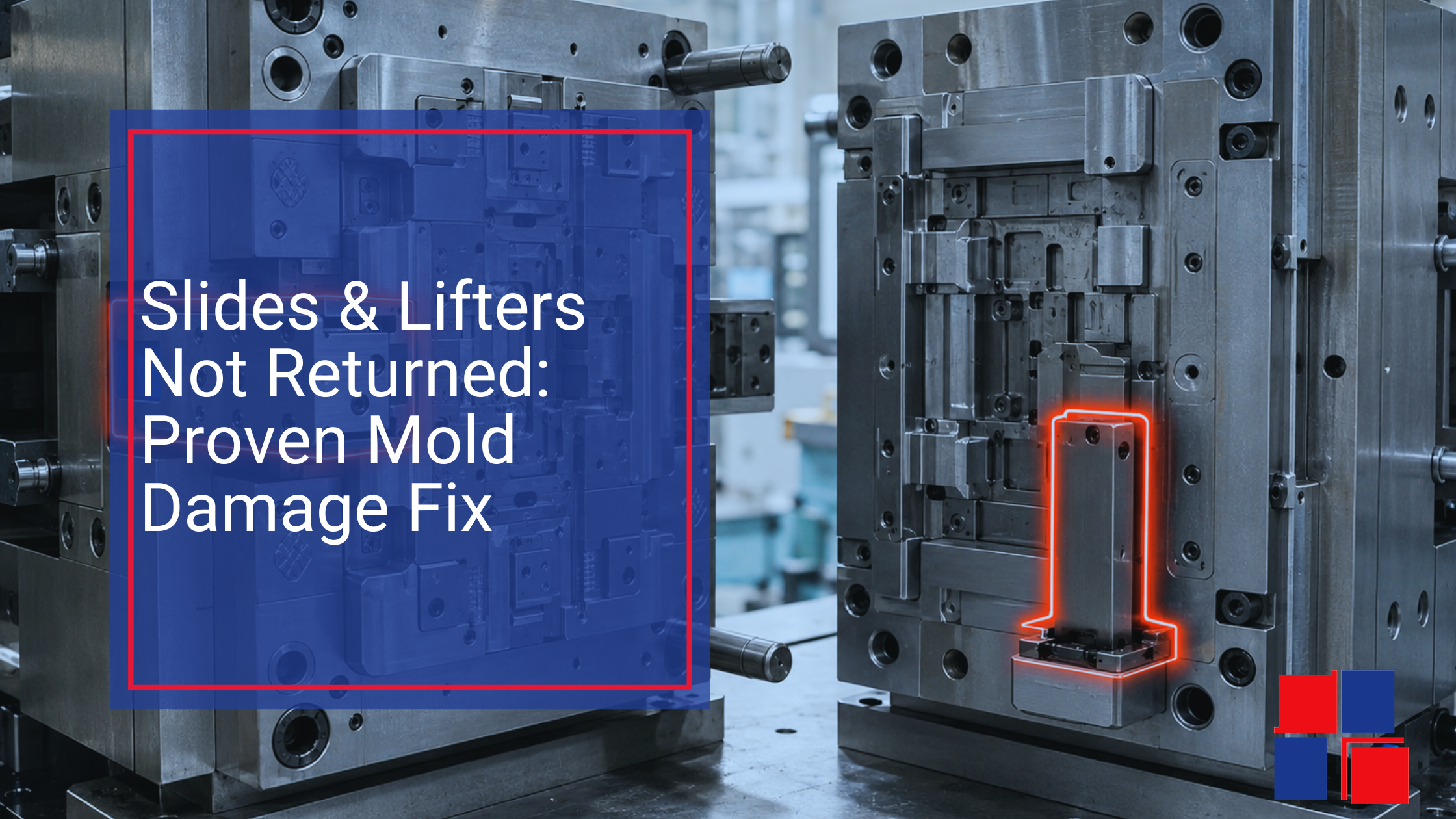
When a slide, lifter, or moving core doesn’t return to its correct position, the next mold close can turn into an expensive failure – shutoff damage, broken lifters, cracked inserts, or worse.
The tricky part? Most “not returned” events are caused by small, repeatable issues that creep in over time – wear, contamination, timing drift, or inconsistent ejection mechanics.
This guide covers:
- what “not returned” really means,
- the hidden causes that create mold damage,
- the warning signs your team can catch early,
- and the best prevention move: verify before mold close.
What does “not returned” mean?
“Not returned” means a mechanical component is not fully seated in its home position before the mold closes. That includes:
- Slides (side actions) not fully retracted/locked
- Lifters not fully seated/flush
- Moving cores not at “home”
- Ejector plate not fully returned
Even a tiny misposition can create metal-to-metal contact at close and damage shutoffs or lifter faces. [1]
Why “not returned” causes mold damage (fast)
Most mold damage happens during the clamp/close stage – when the mold is applying force. If something is out of position, the mold will try to close anyway unless the press or mold protection system prevents it. [1]
That’s why “not returned” events often show up as:
- shutoff chips and galling
- broken lifters/ejectors
- cracked inserts
- flash that suddenly appears after a “mystery event”
- unplanned downtime and repair
Hidden causes of slides & lifters not returning
1) Wear at contact surfaces (gibs, heel blocks, lifter faces)
Wear changes the “true home position,” increases friction, and makes return inconsistent. Lifters are particularly prone to maintenance and processing issues if not designed/maintained correctly. [2]
Quick checks
- witness marks “move” week to week
- lifter face is no longer flush
- new shiny rub lines on gibs/heel blocks
2) Contamination and buildup in pockets/shutoffs
Small chips, flash strings, regrind dust, or grease migration can block full seating.
Quick checks
- pocket/shutoff has new debris patterns
- flash suddenly increases (often from poor shutoff contact)
3) Return mechanism problems (springs, return pins, ejector return)
A slide may move out correctly but fail to return fully due to weak return force, misaligned return pins, or a sticky ejector system. Ejection system misalignment and clearance issues are common drivers of bigger repair work if ignored. [3]
Quick checks
- ejector plate doesn’t return smoothly
- return pins show uneven wear
- “intermittent” return failures after startups
4) Timing drift and inconsistent sequencing
Many not-returned incidents happen around:
- startup
- shift change
- cycle-time adjustments
- robot/EOAT timing changes
Even small delays can leave a component in transition when close begins.
Quick checks
- issue appears only at higher speeds
- issue disappears when cycle is slowed
- operator reports “it happens once per shift”
5) Lubrication issues (too little, too much, wrong place)
Not enough lubrication increases friction; too much can attract debris or migrate to places it shouldn’t. Lifters and sliders are especially sensitive to galling/seizing if lubrication and material pairing aren’t right. [4]
Quick checks
- new drag marks/scoring
- sticky movement by hand during maintenance
- grease buildup in travel path
6) Sensors/interlocks don’t catch “almost returned”
Traditional interlocks or limit switches can miss a condition where a component is close but not fully seated. In-mold sensors can help prevent accidental mold close by verifying positions of ejector plates, slides, and cores. [5]
(Important safety note: safety interlocks should never be bypassed.) [6]
Quick checks
- switch triggers too early (misadjusted)
- inconsistent sensor readings
- “we never see an alarm, but damage still happens”
Warning signs teams often miss
Treat these as early indicators:
- new witness marks / rub lines
- sudden flash or shorts appear after a “normal” run
- cycle time inconsistency
- operators “helping” parts or runners clear
- alarms that come and go without root cause work
Best practice: verify before mold close
The highest-leverage checkpoint in the cycle is right before close:
✅ Part removed
✅ Slides & lifters returned
✅ Moving cores at home
✅ Mold area clear
Vision-based mold protection is specifically used to confirm component position and mold-clear conditions before the next cycle – systems optimized for mold protection can provide flexibility and quick setup. [7]
Quick “Not Returned” troubleshooting flow
- Identify the component
- Slide not returned?
- Lifter not seated?
- Moving core not at home?
- Ejector plate not returned?
- Check mechanical first
- debris in pocket/shutoff
- wear marks, galling, scoring [4]
- return pins / spring force
- ejector plate smooth return [3]
- Check timing and conditions
- does it happen at faster cycles only?
- does it happen after startup or material change?
- does the robot/EOAT path interfere?
- Check detection
- switch location/adjustment
- sensor repeatability
- verify full seating, not “almost home” [5]
FAQs
What causes slides or lifters to not return fully?
Most often: wear, contamination, return mechanism issues, timing drift, and lubrication/galling problems. [2][3][4]
Why does “not returned” create mold damage?
Because damage typically occurs during the close/clamp phase—the mold applies force even if a component is slightly out of position unless prevention stops the close. [1]
Are limit switches enough to prevent close-on-component events?
They help, but they can miss “almost returned” conditions. Many plants use a combination of sensors and verification methods to confirm slides, ejectors, and cores are truly in position. [5]
What’s the safest prevention step?
Verify before mold close (mold-clear conditions). That’s the last, best checkpoint before force is applied.
Download the Mold-Clear Checklist (PDF) — A 1-page guide to verify part release, slides/lifters returned, moving cores at home, and mold area clear before the next close. [Download the checklist]
External References
[1] Huarong — Low-pressure mold protection and common close-stage damage causes
https://www.huarong.com.tw/page/news/en/company_news/detail/191/
[2] Plastics Technology (PTOnline) — Tooling: Having Trouble with Lifters?
https://www.ptonline.com/articles/tooling-having-trouble-with-lifters
[3] Basilius, Inc. — Mold Repair: Ejection Systems (misalignment/clearance issues)
https://www.basilius.com/blog/mold-repair-ejection-systems/
[4] CK Mold — Guide to injection mold sliders (wear, galling, debris, maintenance)
https://ckmold.com/the-complete-guide-to-injection-mold-sliders-are-you-using-them-correctly/
[5] SmartFlow — In-mold sensors verify position of ejectors/slides/cores
https://www.smartflow-usa.com/in-mold-sensors/
[6] OSHA — Horizontal injection molding machines (use interlocks; don’t bypass)
https://www.osha.gov/etools/machine-guarding/plastics-machinery/horizontal-injection-molding-machines
[7] Plastics Technology (PTOnline) — Take a Look at Vision Mold Protection
https://www.ptonline.com/articles/take-a-look-at-vision-mold-protection