

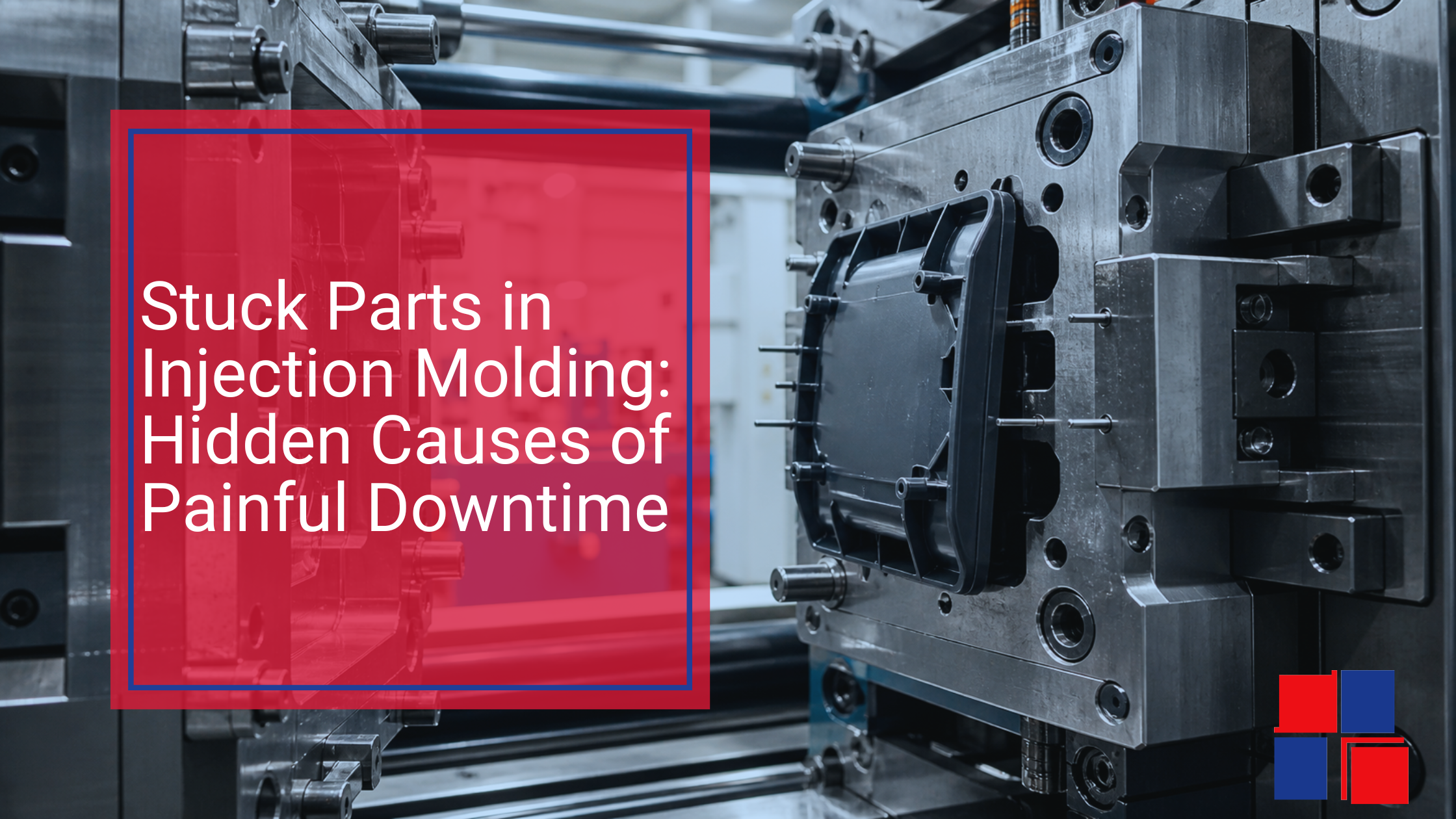
Parts that stick, on the core, in the cavity, on lifters, or on ejector pins, aren’t just a nuisance. They’re a cycle-time killer and a common path to scrap spikes, ejection damage, and “close-on-part” mold crashes.
This guide covers:
- the most common causes of stuck parts,
- the warning signs teams miss,
- and a practical prevention checklist—with a focus on reducing risk before mold close.
What does “stuck part” mean in injection molding?
A stuck part is any condition where the molded part (or runner/sprue) does not release cleanly from the mold at the end of the cycle. It may:
- hang up on ejector pins, ribs, lifters, or shutoffs,
- stay on the “wrong side” of the mold,
- or require manual removal (which often makes the problem worse and increases downtime). [1]
Why stuck parts get expensive fast
Sticking often leads to:
- ejection marks, whitening, cracks, or bent features
- inconsistent cycle time and missed Customer Ship Schedule
- mold safety alarms (and operators bypassing them under pressure)
- higher likelihood of the worst-case event: a part remains in the mold and the next cycle starts [4]
If you’ve ever chased “random flash” or “sudden short shots,” sticking can be the root issue (drag, distortion, incomplete ejection, or closure interference).
The most common causes of stuck parts
1) Not enough draft (or draft fighting texture)
Insufficient draft increases friction and suction, especially on deep walls and textured surfaces. A common rule of thumb is more draft for deeper walls and textured surfaces—sometimes significantly more than teams expect. [3]
What it looks like
- Drag lines, scuffing, “peel” marks
- Part stays on cavity side unexpectedly
- Higher ejector force needed (often felt before it’s measured)
Fixes
- Add/restore draft where possible (or reduce texture depth)
- Confirm parting line alignment and shutoff draft (especially on side-actions) [3]
2) Over-packing or too much hold pressure/time
A common sticking driver is over-packing, which increases shrink grip on the core and makes release harder. [4]
Fixes
- Reduce hold pressure/time (confirm gate seal first)
- Verify transfer position and cushion stability
- Watch for “fixing shorts with pressure” (often creates sticking later)
3) Mold temperature or cooling imbalance
If one side is hotter, the part may cling or warp and bind during ejection. Cooling imbalance can also create localized suction and surface drag.
Fixes
- Confirm stable mold temperatures on both halves
- Inspect cooling circuits for restrictions/scale
- Trend temperature drift (this is where thermal monitoring can pay off)
4) Surface finish issues (tool grain, damage, or polishing direction)
Gouges, worn lifters, tool marks, or polishing “against” the release direction can increase mechanical lock. Polishing direction can matter; guidance often recommends polishing in the direction of part removal. [5]
Fixes
- Inspect lifters/slides for damage and wear
- Correct polish direction; consider coatings where appropriate [5]
5) Ejection system issues (pins, lifters, return, timing)
Sticking can be caused by ejection mechanics, not the part: misaligned pins, uneven pin lengths, weak return, or lifter binding.
Fixes
- Check ejector plate movement and return
- Look for pin witness marks showing uneven ejection
- Verify lifter/slide timing and lubrication strategy
6) Material and release behavior
Some materials and additives are more prone to sticking (especially with high-gloss surfaces or certain elastomer behaviors). Material changes can shift release behavior without obvious parameter changes. [2]
Fixes
- Confirm material lot and regrind % consistency
- Validate melt temp window and residence time stability
- Re-check draft/texture assumptions after resin changes
Warning signs teams miss (before it becomes a crash)
Use these as “early alerts” on the floor:
- Ejector force is creeping up (even if you don’t measure it)
- You see new drag lines or whitening near ribs/pins
- Parts begin sticking after breaks, startups, or shift changes (timing consistency) [2]
- Operators start “helping” parts off the tool (often scratches/undercuts follow) [1]
- You see a sudden rise in downstream symptoms:
- flash (closure interference)
- short shots (process “compensation” or venting issues)
Prevention checklist that works in real plants
Tooling and design
- Confirm adequate draft for depth + texture [3]
- Reduce deep texture where release is critical
- Ensure shutoffs/side-actions have proper draft to avoid damage [3]
- Maintain lifters/slides (wear, timing, polish direction) [5]
Process
- Avoid “packing your way out of problems” (over-pack drives sticking) [4]
- Stabilize hold pressure/time after confirming gate seal
- Keep mold temperature stable; investigate cooling imbalance early
Operations
- Standardize startup and part removal timing (consistency matters) [2]
- Create a “sticking response” SOP (so fixes don’t vary by shift)
- Track where it sticks (core/cavity/lifter/pin) before changing settings
Download the Mold-Clear Checklist (PDF)
Use this 1-page checklist before the next mold close to reduce close-on-part events, scrap spikes, and painful downtime. [Download the checklist]
“Before mold close” prevention: how to reduce crash risk
The highest-risk scenario is simple: the part didn’t eject, and the cycle continues. [1]
For mold protection, the most effective mindset is:
- verify the mold area is clear (part removed, slides returned)
- only then allow the next close
That’s the logic behind vision-based mold protection: confirm the condition right before close, and alarm/stop if something is wrong.
Fast troubleshooting flow (5 minutes to directionally right)
- Where is it sticking?
- Core side grip → draft/pack/cooling imbalance [3][4]
- Lifters/slides → wear, polish direction, timing, damage [5]
- Pins/ribs → ejection imbalance, pin length/return, venting marks
- Did anything change?
- Resin lot / regrind %
- texture change or tool maintenance
- hold pressure/time adjustments
- Make one change at a time
- If sticking is new, resist the urge to “turn up pressure.” Over-pack often makes it worse. [4]
FAQs
What’s the most common cause of parts sticking in injection molding?
The biggest repeat offenders are insufficient draft, over-packing/too much hold, surface/texture friction, cooling imbalance, and ejection/lifter wear or timing issues. [3][4][5]
How do you stop parts from sticking without increasing scrap?
Start with the “no-regrets” checks: draft/texture assumptions, polish direction, lifter/pin wear, and cooling balance—then reduce over-pack (pressure/time) after confirming gate seal. [3][4][5]
Why do stuck parts lead to mold damage?
If a part (or runner) remains in the mold and the next cycle starts, it can interfere with closure and damage shutoffs, lifters, slides, or cores. Repeated manual “unsticking” can also scratch parts and worsen release issues. [1]
Can vision help prevent stuck-part crashes?
Yes, vision can be used to verify “mold clear” conditions (part removed, components returned) right before close, and trigger an alarm/stop when conditions are unsafe.
Related reading on Avalon
- Hidden causes of Flash in injection molding
https://avalonvision.com/2026/04/07/flash-in-injection-molding-causes-troubleshooting/ - What really causes short shots in injection molding?
https://avalonvision.com/2026/03/24/short-shots-in-injection-molding-causes-detection/ - Prevent catastrophic injection mold failures with MoldWatcher
https://avalonvision.com/2025/03/03/prevent-catastrophic-injection-mold-failures-with-moldwatcher-the-ultimate-mold-protection-solution/ - The true cost of downtime: why preventative vision inspection matters
https://avalonvision.com/2025/03/19/the-true-cost-of-downtime/ - Thermal imaging for vision mold protection
https://avalonvision.com/2023/02/18/thermal-imaging-for-vision-mold-protection/
External References
[1] Plastics Technology (PTOnline) — Are Your Sprue or Parts Sticking? Here Are Some Solutions
https://www.ptonline.com/articles/injection-molding-are-your-sprue-or-parts-sticking-here-are-some-solutions
[2] Plastics Technology (PTOnline) — Sticking Sprues or Parts: Lots of Possible Causes and Solutions
https://www.ptonline.com/articles/sticking-sprues-or-parts-lots-of-possible-causes-and-solutions
[3] Protolabs — Improving Part Moldability With Draft
https://www.protolabs.com/resources/design-tips/improving-part-moldability-with-draft/
[4] Asaclean — Injection Molding Defects: Parts Sticking in the Mold
https://www.asaclean.com/blog/injection-molding-defects-parts-sticking-in-the-mold
[5] PlasticsToday — The Troubleshooter: How to Fix Part and Runner Sticking
https://www.plasticstoday.com/injection-molding/the-troubleshooter-how-to-fix-part-and-runner-sticking-in-injection-molding-processes