

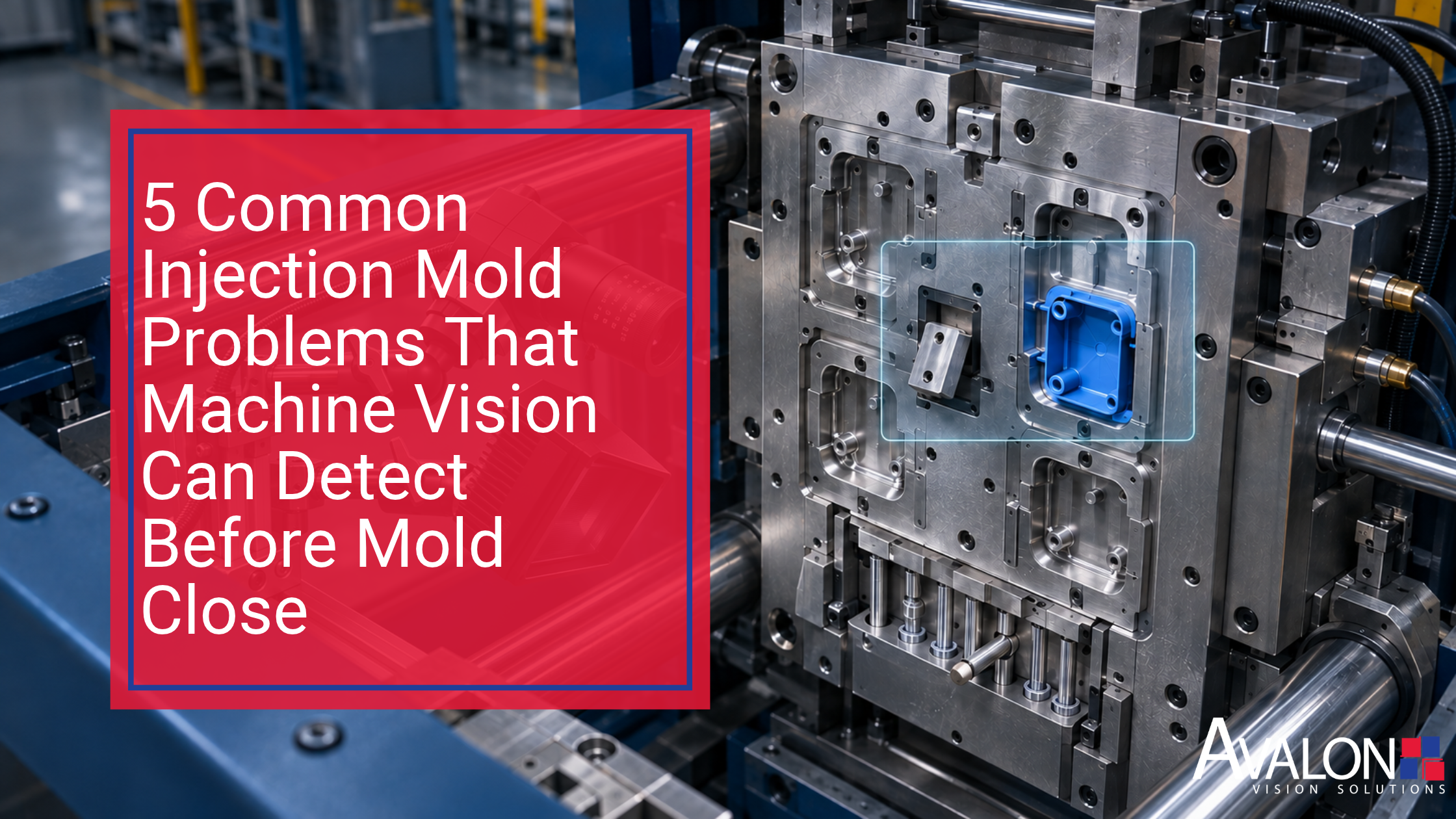
In injection molding, a single overlooked problem can lead to damaged tooling, unexpected downtime, and costly production delays. A molded part that fails to eject, a moving core that does not return to position, or an obstruction left inside the mold can quickly turn a routine production cycle into an expensive repair.
For manufacturers running high-volume production, these risks become even more significant. Every cycle depends on the mold being ready for the next operation.
Machine vision mold protection helps manufacturers identify potential problems before the mold closes, allowing the system to stop the machine before damage occurs.
By inspecting critical areas of the mold during the injection molding cycle, automated machine vision systems such as Avalon Vision Solutions’ MoldWatcher™ provide an additional layer of protection beyond traditional mold safety measures.
Here are five common injection molding problems that machine vision can help detect before they lead to serious tooling damage.
1. Stuck Parts and Incomplete Part Ejection
One of the most common causes of mold damage is a molded part that does not eject completely.
During a normal injection molding cycle, the mold opens, the finished part is released, and the mold prepares to close for the next cycle. However, parts can occasionally remain attached to the core, cavity, or other mold components.
Common causes of stuck parts include:
- Insufficient draft angles
- Inconsistent cooling or shrinkage
- Ejector system problems
- Excessive packing pressure
- Worn or damaged mold surfaces
When a part remains inside the mold and the machine attempts to close, the resulting interference can damage cavities, cores, and other precision tooling components.
How Machine Vision Helps
A machine vision system can inspect the mold during the ejection sequence to verify whether molded parts are present when expected and absent after ejection.
If a part remains in a monitored location after ejection, the system can prevent the next mold-close operation until the issue is resolved.
This additional verification helps manufacturers reduce the risk of mold crashes associated with incomplete part removal.
Related Reading: Stuck Parts in Injection Molding: Causes & Prevention
2. Missing or Misplaced Inserts
Insert molding is commonly used to integrate metal or other components into plastic parts. These inserts must be properly positioned before the mold closes and the injection process begins.
A missing, shifted, or incorrectly seated insert can create production problems, including defective parts and potential tooling damage.
Insert placement issues may result from:
- Improper manual loading
- Robot placement errors
- Insert movement during handling
- Inconsistent positioning fixtures
- Debris interfering with placement
Even a small positioning error can affect the finished part or create interference with mold components.
How Machine Vision Helps
Machine vision systems can be configured to inspect designated insert locations before the next molding operation.
By comparing the observed condition against the established inspection requirements, the system can help identify missing or improperly positioned inserts.
When an insert fails inspection, the machine can be prevented from proceeding until the issue is corrected.
For insert molding applications, this type of verification can support both mold protection and consistent product quality.
3. Moving Cores That Are Not Properly Positioned
Moving cores allow injection molders to produce complex part geometries, including undercuts, holes, and other features that cannot be formed using a simple open-and-close mold design.
However, these components must move into the correct positions at specific points during the molding cycle.
When a moving core fails to reach its required position, it can interfere with other mold components or prevent proper shutoff.
Common causes include:
- Mechanical wear
- Debris or material buildup
- Hydraulic or pneumatic problems
- Incorrect sequencing
- Misalignment
- Incomplete core movement
A core that appears close to its intended position may still create interference when the mold closes.
How Machine Vision Helps
Machine vision can provide an additional method of verifying that a moving core has reached its required inspection position.
Rather than relying exclusively on mechanical or electrical position confirmation, a properly configured vision system can inspect the visible core position at the appropriate point in the cycle.
If the component does not match its expected condition, the system can inhibit mold closure.
This is especially valuable for complex molds with moving components that must operate in a precise sequence.
Related Reading: How to Prevent Mispositioned Moving Cores: Root Causes and Proven Solutions
4. Slides and Lifters That Fail to Return
Slides and lifters are essential components in many complex injection molds. They help create features that require movement beyond the primary mold-opening direction.
Like moving cores, these components must operate in the correct sequence and reach their required positions before the next operation.
A slide or lifter that fails to return properly can create interference, damage shutoff surfaces, or affect part ejection.
Some common contributing factors include:
- Worn sliding surfaces
- Insufficient lubrication
- Contamination or debris
- Damaged mechanical components
- Improper timing
- Inconsistent return mechanisms
These issues may develop gradually, making them difficult to identify until a failure occurs.
How Machine Vision Helps
A machine vision mold protection system can be configured to inspect visible slides and lifters at designated points in the molding cycle.
If a monitored component has not returned to its expected position, the system can prevent mold closure until the condition is corrected.
By checking critical components during each applicable cycle, manufacturers can add another layer of protection against mechanical failures that might otherwise go unnoticed.
Related Reading: Slide Not Returned: How to Prevent Costly Mold Damage
5. Ejector Pins or Ejector Components That Fail to Return
Ejector systems are responsible for releasing molded parts from the mold after the injection and cooling stages.
Once ejection is complete, ejector components must return to their required positions before the next mold-close operation.
When ejector pins or related components remain extended unexpectedly, they can interfere with tooling or other moving components.
Potential causes include:
- Mechanical binding
- Broken or weakened return components
- Debris in the ejector mechanism
- Damaged or bent ejector pins
- Wear within the ejector system
These conditions can lead to damage or production interruptions if the next cycle continues.
How Machine Vision Helps
Machine vision can be configured to monitor visible ejector components and verify their positions during the appropriate inspection stage.
If a monitored ejector component does not match the expected position, the system can inhibit the next machine action.
This allows operators to investigate the issue before the mold attempts to close.
Why Detecting Problems Before Mold Close Matters
Injection molds are precision manufacturing tools, and repairs can be expensive and time-consuming.
When a problem is discovered only after a mold closes, manufacturers may face more than the cost of repairing damaged components.
The consequences can include:
- Unplanned downtime: Production may stop while the tool is inspected or repaired.
- Higher maintenance costs: Damaged cores, cavities, and moving components may require repair or replacement.
- Production delays: Interrupted production can affect scheduling and customer deliveries.
- Increased scrap: Mold-related problems can contribute to defective or unusable parts.
- Reduced productivity: Operators and maintenance personnel must spend time responding to preventable failures.
Detecting an abnormal condition before the next critical machine movement gives production teams an opportunity to correct the problem before it becomes more serious.
How MoldWatcher Helps Protect Injection Molds
Avalon Vision Solutions’ MoldWatcher™ uses non-contact machine vision technology to inspect injection molds during production.
Depending on the application and system configuration, MoldWatcher can help verify:
- Proper part presence and removal
- Insert presence and positioning
- Moving core positions
- Slide and lifter positions
- Ejector component positions
MoldWatcher uses images captured at designated points in the molding cycle to inspect critical areas of the mold.
When the system detects a condition that does not meet the established inspection criteria, it can inhibit specific machine actions, including mold closure.
This approach helps manufacturers identify potential problems before they result in tooling damage, while supporting more consistent production processes.
Machine vision does not replace routine mold maintenance, proper machine setup, or existing safety systems. Instead, it provides an additional inspection method that helps verify critical conditions during production.
Frequently Asked Questions About Machine Vision Mold Protection
What is machine vision mold protection?
Machine vision mold protection uses cameras and image inspection technology to monitor critical areas of an injection mold during production. It helps detect abnormal conditions, such as stuck parts or incorrectly positioned mold components, before the machine proceeds with certain operations.
Can machine vision prevent injection mold damage?
Machine vision can help prevent damage by detecting defined problems before mold closure or other critical machine actions. Its effectiveness depends on camera visibility, inspection configuration, machine integration, and the type of problem being monitored.
What problems can MoldWatcher detect?
Depending on the application, MoldWatcher can inspect for stuck parts, missing or misplaced inserts, improperly positioned cores, slides, lifters, and ejector components. Other inspections may also be possible based on system configuration.
Is machine vision mold protection suitable for automated injection molding?
Yes. Machine vision mold protection can be integrated into automated molding applications to inspect critical conditions during the production cycle. Inspection timing and machine interface requirements depend on the equipment and application.
Does machine vision replace traditional mold protection?
No. Machine vision complements traditional mold protection methods by providing visual verification of selected mold conditions. It should be used alongside appropriate machine safety systems, maintenance procedures, and process controls.
Protect Your Molds Before Problems Become Expensive
Injection molding problems do not always begin with a major mechanical failure.
Sometimes, a single stuck part, misplaced insert, or improperly positioned component is enough to cause significant damage when a mold closes.
Adding automated visual inspection at critical points in the molding cycle helps manufacturers identify these conditions before they escalate.
Avalon Vision Solutions’ MoldWatcher provides machine vision mold protection designed to help manufacturers safeguard expensive tooling and minimize unplanned production interruptions.
Want to see how machine vision could help protect your injection molds?
Contact Avalon Vision Solutions to Request a Free Online 45-Minute MoldWatcher Demonstration
Learn how MoldWatcher can be configured to inspect critical areas of your molding process and help protect your investment.