

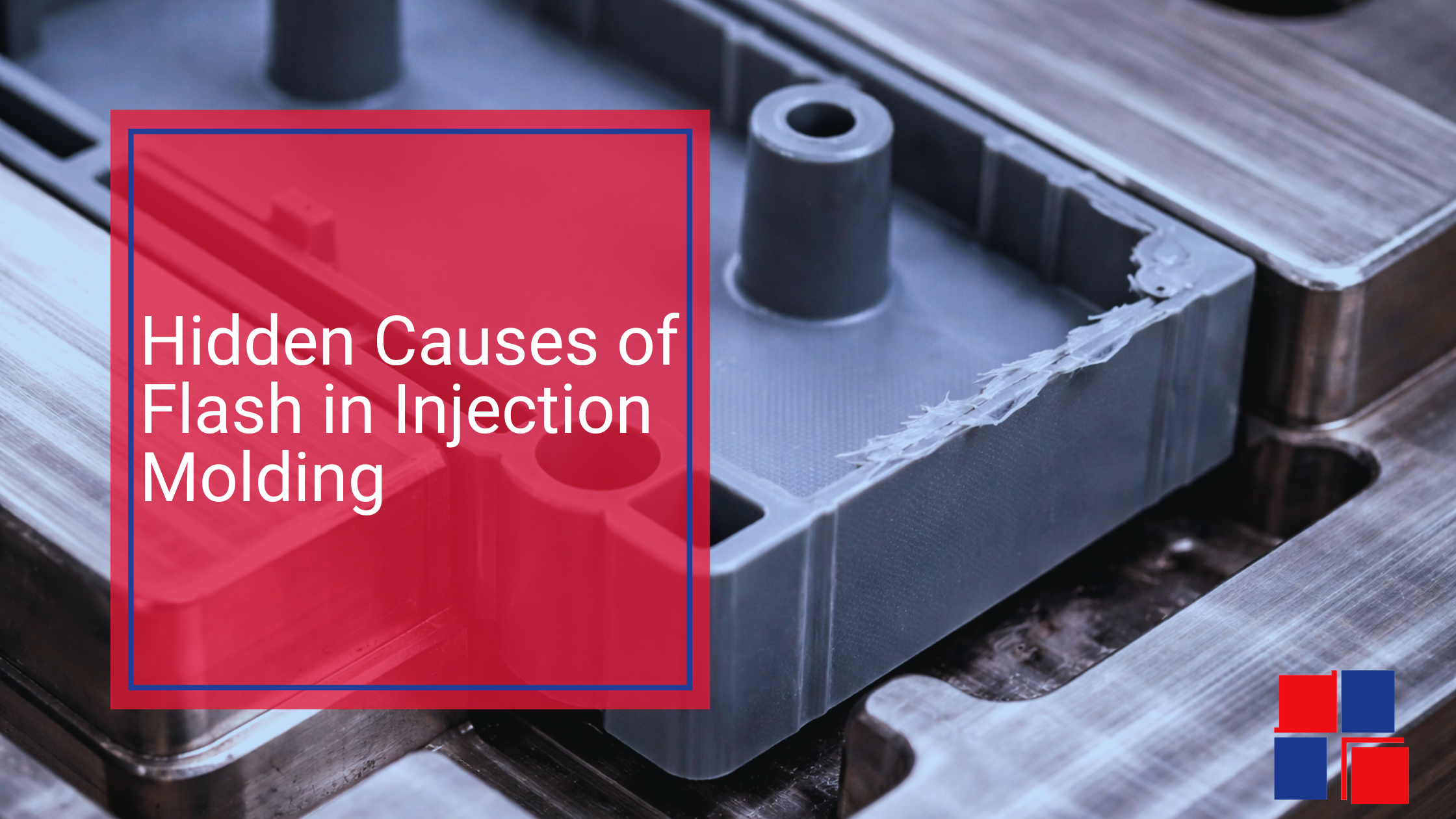
Flash in injection molding is one of the most common defects in injection molding.
It occurs when molten plastic escapes the mold cavity and solidifies along mold interfaces such as the parting line, ejector pins, inserts, or slides.
For molding teams, flash creates several immediate problems:
- additional trimming or secondary operations
- increased scrap rates
- dimensional variation
- potential tooling wear or damage
Flash typically indicates that cavity pressure or mold conditions have moved outside the process window. Identifying the root cause quickly is critical to restoring stable production.
What is flash in injection molding?
Flash is excess plastic that forms outside the intended geometry of a molded part.
It most often appears as thin plastic along mold interfaces, including:
- parting lines
- ejector pin locations
- inserts
- slide interfaces
- vent areas
Flash occurs when molten plastic enters gaps between mold components during the injection or packing phases of the molding cycle.
Why flash occurs
Flash occurs when melt pressure and mold conditions allow plastic to enter small gaps between mold components, often because cavity pressure exceeds the available sealing force at those interfaces.
This can result from process conditions, tooling conditions, or mechanical issues in the molding cycle.
Common root causes include:
- excessive injection pressure
- excessive packing pressure
- high melt temperature
- high mold temperature
- insufficient clamp force
- worn or damaged tooling
- incomplete part ejection
Many flash problems arise from a combination of process variables and tooling conditions, rather than a single parameter change.
Common causes of flash in injection molding
Excessive injection pressure
If injection pressure is too high, molten plastic can be forced into small clearances between mold components.
This commonly produces flash along the parting line or around inserts.
Reducing injection pressure or adjusting fill speed may resolve the issue.
Excessive packing pressure
Packing pressure compensates for material shrinkage after filling, but excessive packing pressure can force material outside the cavity boundary.
Flash occurring near the gate or thick sections of the part often indicates excessive packing pressure.
High melt temperature
Higher melt temperatures reduce material viscosity, allowing plastic to flow more easily into small gaps in the mold.
While higher temperatures may improve filling, they can also increase the likelihood of flash.
Insufficient clamp force
Clamp force must be sufficient to keep mold halves fully closed during injection.
If clamp force is too low relative to cavity pressure, the mold may separate slightly during filling, allowing material to escape.
Flash appearing evenly along the parting line is often associated with clamp force issues.
Worn or damaged tooling
Tool wear increases clearances along the parting line and other mold interfaces.
Even small increases in clearance can allow molten plastic to escape under pressure.
Flash that consistently appears in the same location is often a sign of tooling wear.
Part stuck in the mold during ejection
Flash can also occur when a molded part fails to eject completely.
If a part remains partially in the cavity and the mold closes for the next cycle, the trapped part can prevent the mold halves from fully seating.
This creates a small gap along the parting line or cavity surface. During the next injection cycle, molten plastic can escape through this gap and form flash.
In more severe cases, closing the mold on a trapped part can damage cavity surfaces or mold components.
This issue may indicate:
- insufficient draft
- part sticking in the cavity
- inadequate ejector force
- surface finish issues
- incomplete ejection detection
Where flash typically appears
Flash is most often observed at mold interfaces where two surfaces meet.
Common locations include:
- parting lines
- ejector pins
- inserts
- slides and lifters
- vent locations
Because these areas involve mechanical interfaces, they are the most likely locations for plastic to escape when cavity pressure increases.
Table: Flash causes and detection clues
| Cause | Process Indicator | Typical Flash Location |
| Excessive injection pressure | High cavity pressure | Parting line |
| Excessive packing pressure | Over-packed parts | Near gate |
| High melt temperature | Increased flow | Thin mold interfaces |
| Low clamp force | Mold separation | Entire parting line |
| Worn tooling | Increased mold clearance | Consistent location |
| Incomplete ejection | Mold not fully closing | Mold edges or cavity surfaces |
Early warning signs of flash
Flash rarely appears suddenly without warning.
Early indicators often include:
- thin plastic edges appearing intermittently
- flash occurring only in specific cavities
- increased trimming requirements
- parts sticking during ejection
- inconsistent part weight
Detecting these early signs helps prevent larger scrap events or tooling damage.
How automated inspection can help detect flash
Many molding operations use automated inspection or monitoring systems to detect part anomalies during production.
Inspection systems can identify conditions such as:
- flash along parting lines
- excess material on molded parts
- geometry changes caused by overpacking
- inconsistencies between cavities
By capturing inspection images, alarms, and event records tied to molding cycles, these systems provide additional visibility into process events.
Technologies such as MoldWatcher and ThermalWatch help improve press-side visibility by identifying abnormal conditions during molding cycles and documenting inspection events.
This type of monitoring can help teams identify process changes sooner and reduce troubleshooting time.
Key takeaways for injection molding managers
- Flash occurs when molten plastic escapes the mold cavity during injection or packing.
- Excessive pressure, temperature, tooling wear, and clamp force issues are common causes.
- Flash may also occur when parts remain stuck in the mold during ejection and prevent full mold closure.
- Early detection helps reduce scrap, tooling damage, and production downtime.
- Press-side monitoring and inspection systems can help identify part anomalies sooner.
FAQ
What causes flash in injection molding?
Flash occurs when molten plastic escapes the mold cavity due to excessive pressure, temperature, tooling wear, insufficient clamp force, or mold closure issues.
Where does flash usually appear?
Flash most commonly appears along parting lines, ejector pins, inserts, slides, or other mold interfaces.
Can a stuck part cause flash?
Yes. If a molded part remains stuck in the cavity and the mold closes on it during the next cycle, the mold may not fully close. This can create a gap that allows molten plastic to escape, producing flash.
Is flash a tooling problem or a process problem?
Flash can result from both tooling issues and process conditions. Root causes often involve a combination of pressure, temperature, tooling wear, and mold alignment.
References
Rosato, D. V., & Rosato, M. G. Injection Molding Handbook. Springer.
Beaumont, J. P. Runner and Gating Design Handbook: Tools for Successful Injection Molding. Hanser Publications.
RJG, Inc. “The Two Causes of Flash and How to Troubleshoot Them.” RJG, https://rjginc.com/the-two-causes-of-flash/
RJG, Inc. “Clamp Force: Why It’s Vital to Your Injection Molding Process and How to Calculate It.” RJG, https://rjginc.com/clamp-force-why-its-vital-to-your-injection-molding-process-and-how-to-calculate-it/
Fictiv. “Troubleshooting Injection Molding Flash.” Fictiv, https://www.fictiv.com/articles/injection-molding-flash
RJG, Inc. “How to Troubleshoot 9 Common Defects in Injection Molded Parts.” RJG, https://rjginc.com/how-to-troubleshoot-9-common-defects-in-injection-molded-parts/